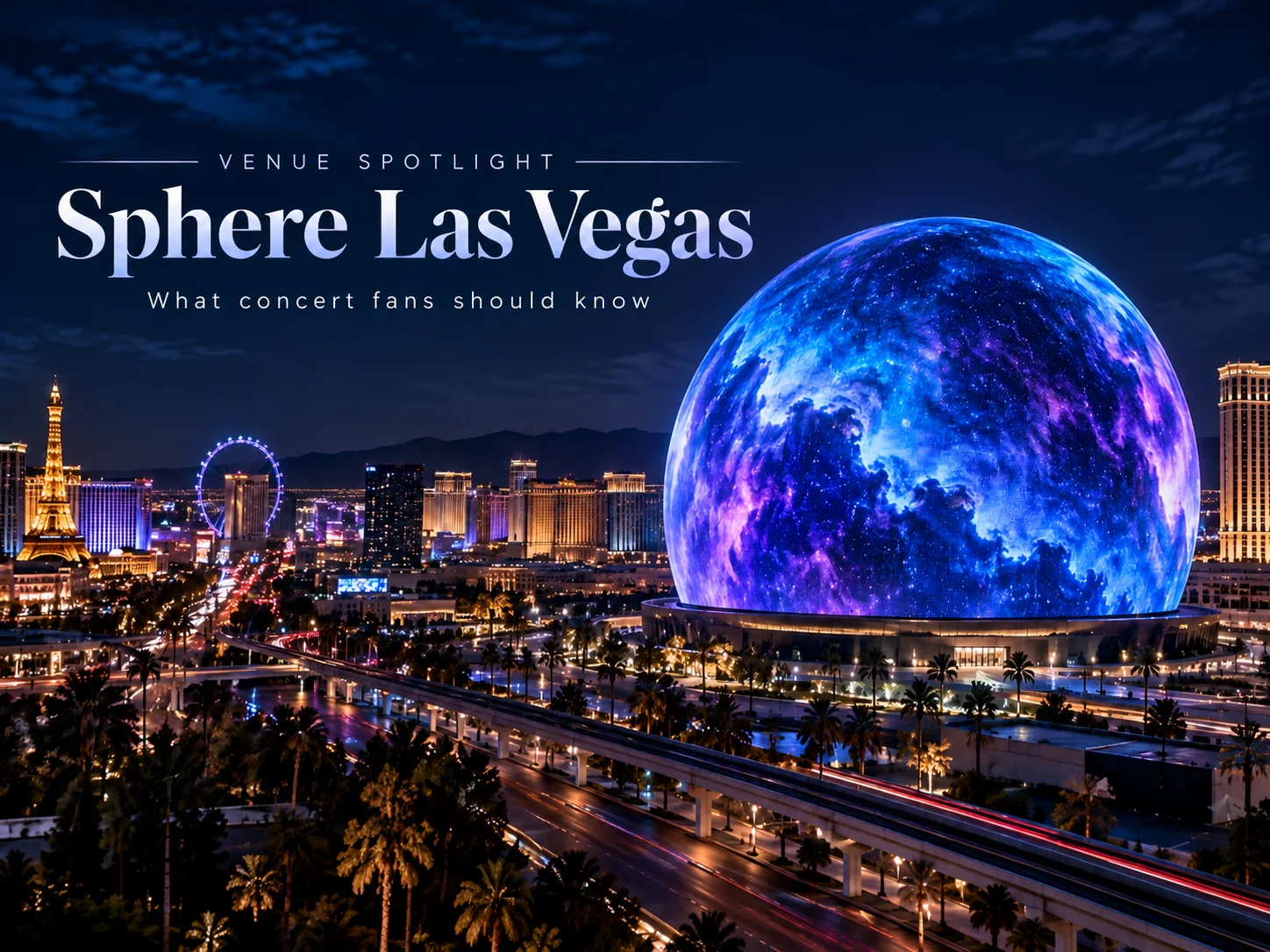
Sphere Las Vegas — What Concert Fans Should Know
There are concert venues where the building mostly disappears once the lights go down.
Sphere in Las Vegas is not one of them.
From the moment its enormous illuminated exterior appeared on the Las Vegas skyline in 2023, Sphere was designed to be part of the show itself. As opposed to other concert venues, artists are not simply performing in front of a large video screen. They are performing inside a room built around a 160,000-square-foot LED display that curves up, over and around the audience. This fully immersive display is paired with about 168,000 speakers positioned behind the screen.
For concert fans, the Sphere is a game-changer.
The closest seat to the stage is not necessarily the seat you will want most. Upper-level seats that might ordinarily be dismissed as “nosebleeds” can provide spectacular views of the full visual production. And the sound system — something that receives nearly as much praise from concertgoers as the screen — was designed to place and direct audio throughout the room rather than simply blast it outward from conventional speaker stacks. The result is something somewhere between a concert, a giant-format movie and an immersive art installation.
A concert venue unlike almost anything before it
Sphere opened its doors for U2’s U2:UV Achtung Baby Live at Sphere residency in September 2023. The opening performances immediately demonstrated both the possibilities and the challenge of playing inside the venue. U2 performed against enormous floor-to-ceiling graphics, while The New York Times noted something particularly important about Sphere: sometimes the building itself can become such a powerful visual presence that the performer almost has to compete with it. That tension has become part of what makes Sphere concerts interesting.
Phish approached the room differently. During its performances, the enormous screen transformed into environments ranging from a star-filled night sky to an underwater kelp forest. The Los Angeles Times also singled out the detailed sound and the physical sensation produced by seat haptics during portions of the performance. Dead & Company took another approach, surrounding the audience with imagery from Grateful Dead history, psychedelic animation and scenes that appeared to transport the entire venue through different environments. Concert accounts frequently singled out the band’s “Drums” and “Space” sequences as showcases for Sphere’s spatial audio and low-frequency effects.
And for the Eagles, Sphere has provided a completely different backdrop: elaborate cinematic imagery accompanying music that was originally created decades before immersive digital venues existed. The Eagles themselves describe the residency as combining their catalog with Sphere’s wraparound display and spatial audio technology.
That is an important point for first-time visitors: there really is not one standard “Sphere concert.” The building provides the canvas. The artist decides how much of that canvas to use.
What does the screen actually feel like from inside?
Photographs do not quite communicate the scale.
Sphere’s interior LED surface covers approximately 160,000 square feet — more than three acres — and wraps upward and over the audience rather than sitting only behind the stage. A performer might appear against a traditional background one moment. Minutes later, the architecture around you can appear to disappear entirely, replaced by a desert, outer space, a psychedelic landscape or another environment created specifically for the show. That illusion has been one of the recurring themes in reviews of Sphere concerts. During Phish, for example, one scene was rendered as a starry sky so convincingly that the Los Angeles Times compared the effect to having the building’s roof disappear.
The surprise for many fans: the sound
The giant screen gets the photographs, but the audio may be a more impressive technological achievement.
Sphere says its sound system uses approximately 168,000 speakers behind the LED surface, along with technologies including wave-field synthesis that allow sound to be directed and positioned around the venue. That is not just marketing language that disappears once people attend a show. Across concert reports from U2, Phish, Dead & Company and other residencies, sound quality is one of the most consistently praised aspects of Sphere. Fans repeatedly describe unusually clear separation between instruments and vocals, including from seats far from the stage. That is a major difference from a conventional arena, where concertgoers often choose seats partly based on their relationship to speaker arrays. At Sphere, your seat is also part of an audio environment.
Where should you sit at Sphere?
This may be the most useful question in the entire article — and it does not have one universal answer.
If your main priority is being close to the artist, the floor or lower sections naturally provide more of the traditional concert experience.
But if your priority is experiencing Sphere itself, sitting farther back can actually be an advantage.
Concertgoers who have attended multiple shows frequently favor centered seats in the 200 and 300 levels because they provide a balance between seeing the performers and taking in the full screen. Some fans prefer the 300 level in particular for that reason. Higher seats can also produce striking views because the audience is able to see a much larger portion of the visual canvas without continually looking upward. Reports from the 400 level regularly describe excellent full-screen views, although performers on the stage naturally appear smaller from that distance.
The floor offers the opposite tradeoff. You are closer to the musicians and in the middle of the concert energy, but the screen extends so far above you that taking in the entire image can require looking almost straight upward. Some fans love that feeling; others who have tried both floor and reserved seating say they preferred having a seat farther back for the complete Sphere experience.
So instead of asking only, “How close can I get?” a better Sphere ticket-shopping question may be: “Do I care more about seeing the band or seeing the room?” That answer can help determine which section makes the most sense.
Be especially careful about obstructed-view seats
There is one seating issue first-time visitors should understand before purchasing.
Some lower-level seats toward the rear can sit beneath an overhang. You may still have a perfectly good view of the performers, but part of Sphere’s enormous overhead display can be blocked. That is a considerably bigger compromise at Sphere than it might be in an ordinary arena. Recent seat reports continue to document the difference. Visitors in some rear 100-level locations describe excellent views of the stage but substantially reduced views of the overhead visuals, while centered 300- and 400-level seats frequently receive praise for unobstructed views of the complete production. For that reason, check the disclosure attached to the exact ticket listing, not just the section number.
Haptic seats and other effects: not every concert uses everything
You have probably heard about seats that vibrate, wind effects and other sensory technology inside Sphere.
Those capabilities are real — but do not assume every concert uses all of them.
Sphere states that events may, depending on the production, include seat haptics, movement sensations, flashing or intense lighting, loud sounds, visual effects and atmospheric effects such as fog, scent or wind. Artists decide how those technologies fit their particular show. Some performances have used the haptic system dramatically. Others rely primarily on the screen and spatial audio.
That difference is another reason watching clips from one Sphere residency does not necessarily tell you what another artist’s concert will be like.
Getting into Sphere: what to know before show night
Sphere is located at 255 Sands Avenue, just east of the main Las Vegas Strip.
Walking can be one of the easier approaches if you are staying nearby. There is also pedestrian access from The Venetian, onsite and nearby parking, and a designated rideshare pickup/drop-off area near Manhattan Street and Westchester Drive. Sphere recommends allowing extra travel time on event days because street closures can affect access.
Tickets are mobile only, so Sphere recommends downloading them to your phone’s digital wallet before arriving. The venue is also cashless.
Sphere operates largely as a no-bag venue. Small clutches, purses and fanny packs approximately 6 × 6 × 2 inches or smaller are permitted, along with medical and diaper bags, but larger bags and backpacks are not. There is no onsite bag check.
Those are exactly the kinds of details worth checking again on Sphere’s official website shortly before your concert, because venue policies can change.
Is Sphere worth experiencing at least once?
That is ultimately subjective, but the interesting thing about reading concert reviews is not that everyone agrees about every artist or concert. Some fans prefer a conventional concert where the musicians remain the unquestioned center of attention, whereas Sphere’s massive visuals can occasionally distract from the music. Where there is considerably more agreement is that Sphere provides a concert experience that is genuinely different from a normal arena show, particularly when an artist designs the production around the room.
Do not go expecting merely a bigger video screen.
Go expecting the venue itself to become part of the performance.
And when the right artist, the right visuals and the right song come together, the room can momentarily convince you that you are no longer sitting inside a concert venue in Las Vegas at all.